
Brazil's Emerald Necklace: A Journey into the Serra do Mar Coastal Forests
The Serra do Mar Coastal Forests, an ecoregion confined entirely to Brazil's southeastern and southern coast, protect one of the largest remaining continuous tracts of Atlantic Forest, sheltering the critically endangered black-faced lion tamarin and hundreds of endemic species across seven Brazilian states.

The Serra do Mar Coastal Forests: Brazil's Last Great Stand of Atlantic Forest
The Serra do Mar Coastal Forests, an ecoregion nestled along Brazil's southeastern and southern coast, is a bastion of biodiversity and ecological richness within the Atlantic Forest biome. Covering approximately 104,800 sq km (40,500 sq mi), roughly the size of Ohio, and extending some 1,000 km (620 mi) along the coast, this ecoregion encompasses a mosaic of montane forests, high summits, and lush valleys, creating a haven for many plant and animal species. Despite significant anthropogenic pressures, including urban development and tourism, the Serra do Mar forests remain a vital conservation stronghold and contain some of the largest remaining continuous fragments of Atlantic Forest anywhere in Brazil.
Geography and Climate
The Serra do Mar Coastal Forests ecoregion blankets the slopes and high summits of the Serra do Mar mountain range, extending along the Atlantic coast of southeastern and southern Brazil. Unlike the broader Atlantic Forest biome, of which it forms just one ecoregion among several, the Serra do Mar Coastal Forests lie entirely within Brazil, spanning the states of São Paulo, Rio de Janeiro, Paraná, Minas Gerais, Espírito Santo, Santa Catarina, and Rio Grande do Sul; it is the neighboring Alto Paraná Atlantic Forests ecoregion, further inland, that extends across the border into Argentina and Paraguay. The climate is subtropical, with high annual rainfall ranging from 1,400 to 4,000 mm (55 to 157 in) and no pronounced dry season, sustaining the lush, evergreen rainforests that dominate the landscape.
Flora and Fauna
The Serra do Mar forests boast exceptional biodiversity, with a wealth of endemic species that call this ecoregion home. These forests are teeming with plant life, hosting flowering Cassia and Tibouchina species alongside a rich diversity of orchids, bromeliads (Bromeliaceae), myrtles (Myrtaceae), and laurels (Lauraceae). Notably, over half of the tree species and 92% of the amphibians found in the Serra do Mar forests are endemic, underscoring the ecoregion's significance as a center of endemism; researchers continue to describe new species here regularly.
The avian diversity in this region is particularly striking, with 628 recorded bird species, including the harpy eagle (Harpia harpyja), the red-tailed amazon (Amazona brasiliensis), and the black-fronted piping guan (Pipile jacutinga), all threatened species found nowhere else in comparable numbers. Among the 175 mammal species recorded, the muriqui, or woolly spider monkey (Brachyteles arachnoides), South America's largest primate, and the critically endangered black-faced lion tamarin (Leontopithecus caissara), one of the rarest primates on Earth and restricted to a small stretch of forest along the São Paulo-Paraná coastline, both depend on this ecoregion for their survival, alongside elusive predators like the jaguar (Panthera onca) and ocelot (Leopardus pardalis).
Protection and Conservation Efforts
The Serra do Mar Coastal Forests have lost an estimated 70% of their original extent to deforestation, yet the ecoregion retains a higher proportion of intact habitat than most of the wider Atlantic Forest, with approximately 36% currently under some form of protection, anchored by major reserves including Serra do Mar State Park, Brazil's largest Atlantic Forest protected area at 315,000 hectares, and Serra da Bocaina National Park, which spans the São Paulo-Rio de Janeiro border and protects both coastal lowland forest and high-elevation grasslands within a single reserve.
The steep, mountainous terrain that defines the Serra do Mar has itself functioned as an inadvertent conservation ally: unsuitable for large-scale agriculture, it has allowed forest to survive here even as the flatter Atlantic Forest fragments further inland were cleared almost entirely. Even so, ongoing efforts are needed to mitigate the impacts of habitat fragmentation and degradation caused by urban expansion and tourism infrastructure along the coast, ensuring the long-term survival of the endemic species and invaluable ecosystems found within the Serra do Mar forests.
Conclusion
The Serra do Mar Coastal Forests ecoregion is a testament to Brazil's natural heritage, boasting unparalleled biodiversity within the Atlantic Forest biome despite existing entirely within a single, densely populated country. As a vital center of endemism and one of the largest remaining continuous fragments of a forest that has otherwise nearly vanished, these forests serve as a crucial stronghold for species found nowhere else on Earth, from the black-faced lion tamarin to hundreds of endemic amphibians, highlighting the urgent need for concerted conservation efforts to preserve this invaluable ecosystem for future generations.
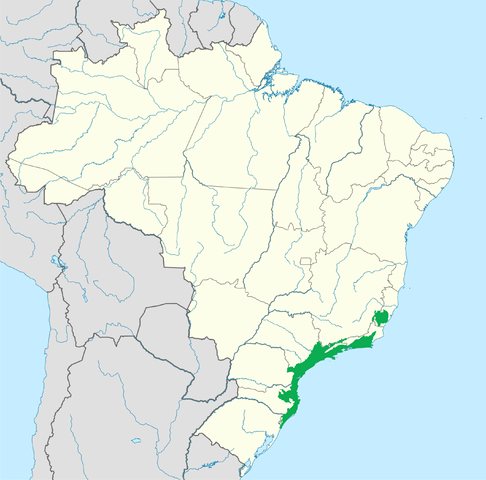
Map of the Serra do Mar coastal forests (in green) as delineated by WWF.