
Kaa-Iya del Gran Chaco: Bolivia's Indigenous-Led Wilderness
Kaa-Iya del Gran Chaco, at 3.4 million hectares, Bolivia's largest national park and one of the biggest protected areas in South America, was created in 1995 at the request of the Izoceño-Guaraní, Chiquitano, and Ayoreode peoples who still co-manage it today — a rare case of a major national park founded and run by the Indigenous communities whose ancestral territory it protects.
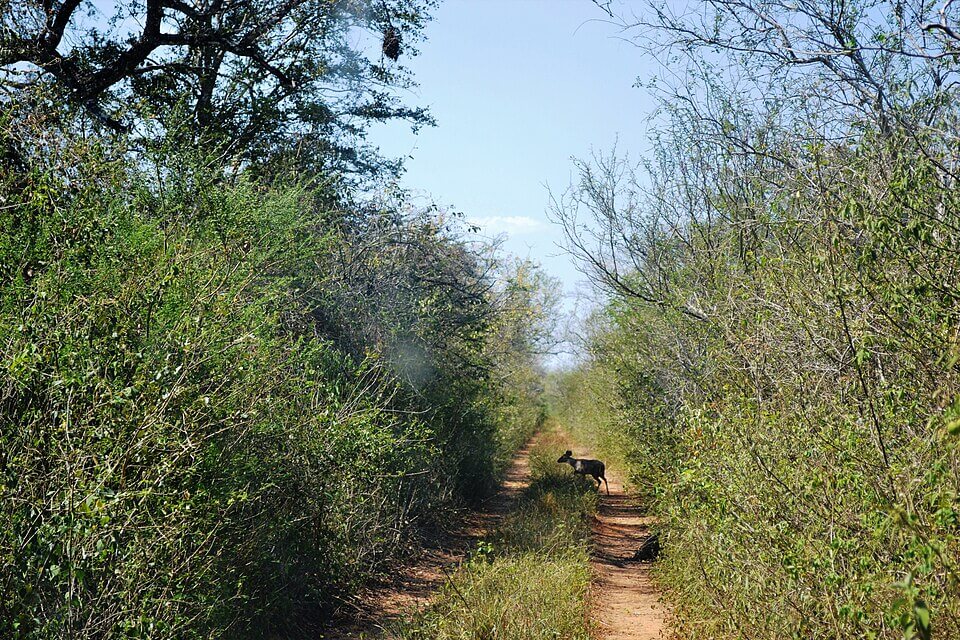
Kaa-Iya del Gran Chaco: The Park the Izoceño-Guaraní Built
In the remote southeastern reaches of Bolivia's Santa Cruz Department, Kaa-Iya del Gran Chaco National Park and Integrated Management Natural Area protects 3,441,115 hectares (34,411 sq km) of the Gran Chaco, an area larger than Belgium and, by most measures, Bolivia's largest national park and one of the largest protected areas anywhere in South America. What sets Kaa-Iya apart from nearly every other park of comparable scale is not just its size, but who created it: rather than being established by the state and imposed on the people living within it, Kaa-Iya exists because the Izoceño-Guaraní, Chiquitano, and Ayoreode peoples of the region asked for it, designed it, and continue to run it today.
A Park Born From Indigenous Initiative
Kaa-Iya's origins trace to 1991, when the Capitanía del Alto y Bajo Izozog (CABI), the political organization representing the Izoceño-Guaraní communities of the Izozog wetlands, partnered with the Wildlife Conservation Society to establish an initial protected area covering part of the region. Over the following four years, CABI, working alongside the Chiquitano and Ayoreode peoples who share the surrounding territory, built the case for a far larger, permanent park, one whose explicit purpose combined conservation of the world's largest remaining tract of Gran Chaco dry forest with formal protection of the Indigenous territories within it. That effort succeeded on September 21, 1995, when the Bolivian government created Kaa-Iya del Gran Chaco by supreme decree. Two months later, on November 24, 1995, the government formalized a co-management agreement with CABI, giving the Izoceño-Guaraní a direct, ongoing role in the park's administration alongside Bolivia's National Service for Protected Areas (SERNAP), a governance model that remains rare among protected areas of this scale anywhere in the world. In 2001, CABI's role in the park's creation was recognized internationally when the organization received Spain's Bartolomé de las Casas award for its conservation work and its protection of Indigenous culture.
Geography and the Bañados de Izozog
Kaa-Iya sits within the Cordillera and Chiquitos provinces of Santa Cruz, spanning the municipalities of Charagua and San José de Chiquitos. The landscape is predominantly open savanna and dry Chaco woodland, generally flat, with elevations ranging from around 100 m (328 ft) up to just over 800 m (2,625 ft) at the park's highest points. In the park's northwest, the Parapetí River feeds an extensive wetland system, the Bañados de Izozog, whose ecological importance was recognized in 2001 with designation as a Wetland of International Importance under the Ramsar Convention, one of two Ramsar-listed areas within the park's boundaries.
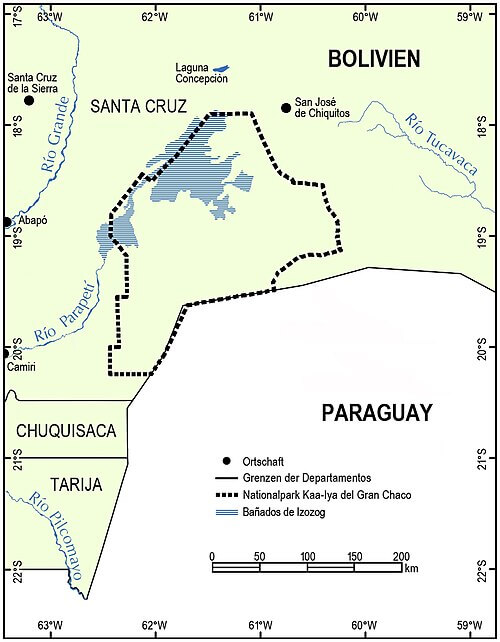
Boundary map of the Kaa-Iya del Gran Chaco National Park.
Three Peoples, One Shared Territory
The Izoceño-Guaraní remain the park's largest resident population, concentrated in more than twenty communities around the Bañados de Izozog in the park's west, including Guarirenda, Rincón, Huirapendi, and Isiporenda among others. Chiquitano communities occupy the park's north, centered on the settlement of San Pablo, while Ayoreode (Ayoreo) groups, including some that remain uncontacted, range across the park's more remote interior. The presence of uncontacted Ayoreo populations here connects Kaa-Iya directly to one of the most urgent Indigenous rights concerns facing the wider Gran Chaco today, since their continued isolation depends entirely on the intact forest the park exists to protect.
A Refuge for the Chaco's Rarest Wildlife
Kaa-Iya protects one of the richest concentrations of Neotropical dry-forest wildlife in South America, with at least 69 documented mammal species, more than 300 bird species, and roughly 90 snake species recorded within its boundaries. Camera-trap surveys within the park suggest a resident jaguar (Panthera onca) population that may number in the hundreds to over a thousand individuals, among the largest concentrations of the species anywhere in its range. The park was established in significant part to protect the Chacoan peccary (Catagonus wagneri), the species presumed extinct for decades before its rediscovery in the 1970s, a story covered in depth in our Gran Chaco article; Kaa-Iya remains one of the peccary's most important remaining strongholds. Other notable residents include the giant armadillo (Priodontes maximus), maned wolf (Chrysocyon brachyurus), puma (Puma concolor), South American tapir (Tapirus terrestris), ocelot (Leopardus pardalis), and black howler monkey (Alouatta caraya).
Layers of History: A Jesuit Mission in the Chaco
Kaa-Iya's remote southeastern corner, near the Bolivia-Paraguay border, holds the ruins of San Ignacio de Zamucos, a Jesuit mission active from 1724 to 1745 among the Zamuco-speaking peoples of the region, whose descendants include today's Ayoreode. The mission's brief history and eventual abandonment reflect the broader, difficult history of Jesuit missionary efforts across the Chaco's Indigenous communities, and its ruins remain a physical record of that history within the park's boundaries today.
Threats and Conservation Outlook
Despite its scale and its indigenous-led governance model, Kaa-Iya faces mounting pressure from deforestation and agricultural expansion along its margins, a threat that mirrors the broader crisis facing the Gran Chaco as a whole, where forest loss has in several recent years outpaced even that of the Brazilian Amazon in relative terms. Illegal hunting and small-scale mining add further pressure within and around the park. Kaa-Iya's co-management structure has, however, proven relatively effective at limiting encroachment compared to more loosely governed protected areas elsewhere in the Chaco, a track record increasingly cited by conservationists as evidence for the value of Indigenous-led management in tropical dry forest conservation more broadly.
Visiting Kaa-Iya
Kaa-Iya remains one of Bolivia's least visited major parks, largely because of its remoteness. Most visitors reach it via Santa Cruz de la Sierra, traveling roughly 260 km (162 mi) along a paved road to San José de Chiquitos before continuing into the park itself. Foreign visitors pay an entrance fee, with reduced rates for Bolivian nationals and students, that goes toward the park's conservation and maintenance. Given the difficulty of access and the sparse infrastructure within the park's interior, most visits are arranged through specialized tour operators or in coordination with CABI and the local communities who continue to call the park home.
Conclusion
Kaa-Iya del Gran Chaco stands as one of the most significant examples anywhere in South America of a protected area created by the very communities whose land it encompasses, rather than around or despite them. Its scale alone makes it critical to the future of the Gran Chaco's dry forest and the Chacoan peccary, jaguar, and Ayoreode communities that depend on it, but its governance model, an ongoing partnership between the Bolivian state and the Izoceño-Guaraní, Chiquitano, and Ayoreode peoples, may prove just as important a legacy, offering a working template for how conservation and Indigenous self-determination can reinforce rather than compete with one another.