
Tolhuaca National Park: Araucaria Forests Born from Chile's Oldest Reserve
Tolhuaca National Park was carved in 1935 from the Malleco reserve, Chile's oldest protected area, and shelters araucaria forests beneath a glacier-scoured volcano, forests that fire has repeatedly tested.
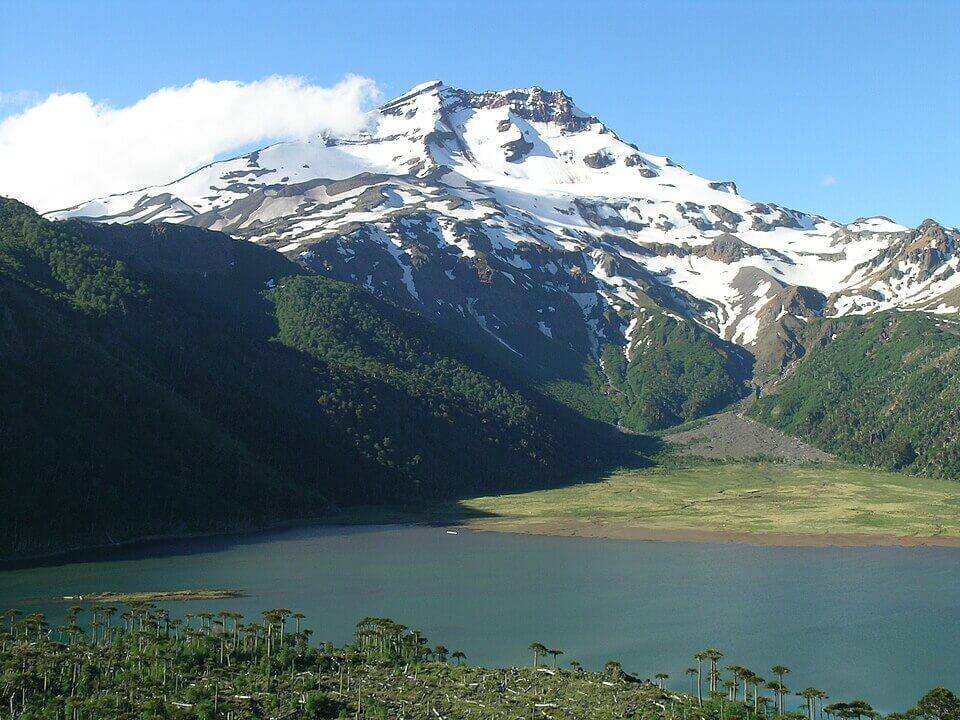
Tolhuaca National Park: A Volcano, a Waterfall, and the Forests That Keep Burning
Tolhuaca National Park lies in the Andean foothills of the Araucanía Region, in the commune of Curacautín, about 140 km (87 mi) from Temuco. It covers 6,374 hectares (about 15,750 acres) of araucaria and southern beech forest, lakes, and waterfalls, and is reached by a gravel road that runs 35 km (22 mi) from Curacautín. The name Tolhuaca is Mapudungun and is usually translated as "cow's brow" or "cow's forehead," a reference to the shape of the volcano that dominates its skyline.
A Reserve Older Than the Park
The land the park occupies has been protected longer than almost any other in Chile. On September 30, 1907, Supreme Decree 1,540 established the Malleco Forest Reserve, driven by foresters such as Federico Albert; Chilean sources describe it as the country's oldest protected area, with some accounts also ranking it among the first in the Americas, though sources vary. The original reserve covered about 33,640 hectares (83,100 acres), with coigüe, roble, lingue, and avellano forest and a smaller share of araucaria.
In October 1935, Decree 2,489 detached part of the reserve as Tolhuaca National Park, at first covering 3,704 hectares (9,150 acres) and banning sawmills and permanent dwellings within its boundaries. A second portion was added in January 1985, bringing the park to its present size, while the remaining Malleco National Reserve, now about 16,625 hectares (41,100 acres), borders it to the north. The park, the reserve, and three other Araucanía protected areas, Conguillío, Huerquehue, and Villarrica national parks, together form the UNESCO Araucarias Biosphere Reserve, designated in 1983.
The Araucaria Forest
The park lies within the Andean-Patagonian forest region, in high-Andean deciduous forest with araucaria and in mixed deciduous forest. Its most prized trees are monkey puzzle trees (Araucaria araucana), which grow here alongside southern beeches such as lenga (Nothofagus pumilio) and coigüe (Nothofagus dombeyi). The araucaria, called pewén in Mapudungun, is sacred to the Mapuche and a traditional food source for the Pehuenche, whose elders have described choosing the oldest araucaria in a forest to kneel before it with prayers and offerings. The tree's bark, up to 15 cm (6 in) thick, is an adaptation that helps it survive fire, a feature repeatedly tested here. Pottery and other artifacts found in the park show that people used this land long before it was protected.
A Volcano on the Skyline
Tolhuaca volcano, a glacier-scoured stratovolcano about 2,800 m (9,200 ft) high, rises just outside the park's boundary on the border between the Araucanía and Biobío regions, northwest of Lonquimay volcano. It last erupted around 4000 BCE, and only fumarolic activity has been recorded in historical times. Its slopes are covered with araucaria forest and dotted with small lakes, and the volcano's heat has drawn commercial interest: a company has been awarded a geothermal exploitation license on its northwest flank, with a first 50-megawatt plant planned and potential for up to 200 megawatts. The Termas de Tolhuaca hot springs lie outside the park, on the road that approaches it from Curacautín.
Lakes, Rivers, and Waterfalls
The Malleco River, the park's main watercourse, rises within its boundaries and, along with other streams, feeds Laguna Malleco, a 76-hectare (188-acre) lake rimmed by old forest that shelters a wide variety of waterbirds. The park's best-known sight is Salto Malleco, a waterfall of about 50 m (164 ft) reached by a 1.7 km (1.1 mi) trail, while the Salto de la Culebra, fed by springs, winds like a snake over its rocks, and the green waters of Laguna Verde are ringed by araucarias. A 400 m (1,300 ft) accessible circuit follows part of Laguna Malleco's shore, and a longer trail of about 12 km (7.5 mi) crosses the park toward the Niblinto area.
Wildlife
The park's forests shelter the pudú (Pudu puda), a small forest deer, and the Magellanic woodpecker (Campephilus magellanicus), which hammers the older trees, while Andean condors (Vultur gryphus) soar above the ridges. Laguna Malleco draws waterbirds, and the park's old-growth stands are a refuge for animals that need large, undisturbed trees.
Fire in the Araucaria Forest
Fire is the park's defining threat. In February 2002, a natural-origin fire swept through Tolhuaca and the Malleco reserve, burning about 60% of the park and roughly 30% of the reserve, as part of a season in which more than 20,000 hectares (49,400 acres) of araucaria forest burned across the region. The 2014–2015 fire season burned more than 12,000 hectares (29,650 acres) in the same protected areas, Malleco and China Muerta national reserves and Conguillío and Tolhuaca national parks, one of the worst seasons in 50 years according to a study published in the journal Oryx. One doctoral study of Tolhuaca's araucarias found that the 2002 fire reduced the trees' growth, while the 2015 fire increased it, suggesting the species may preserve a record of past fires in its rings.
Closures and Pressures
The park's remoteness and fire risk mean frequent closures. CONAF shut it temporarily in November 2022 after a control booth was found burned, in the same week that arsonists destroyed the buildings at Nahuelbuta National Park, and again in February 2023 during the regional wildfire emergency and in January 2025 because of extreme heat. In July 2026, it closed again after heavy rain raised river and lake levels and cut trails, a reminder that the park's mountain climate can be as disruptive as its fire season.
Visiting the Park
The park is open Tuesday through Sunday, and visitors should check CONAF for current road and trail conditions, since the access road is gravel, there is no phone signal, and no food is sold inside. Trails open at the end of 2025 included Laguna Verde, the Mesacura viewpoint, and Salto Malleco, with the road to the La Culebra sector passable with caution. Camping areas and bird-watching routes around Laguna Verde offer a quieter alternative to the more popular Araucanía parks.
Conclusion
Tolhuaca protects a landscape that has been guarded for more than a century, from the 1907 Malleco reserve to the 1935 park and the biosphere reserve that now includes it, yet its araucaria forests remain vulnerable to the same fires that have burned across the region in recent decades. How well it fares will depend on fire prevention in its remote forests and on how Chile balances protection with development pressures, such as geothermal energy, on the volcano above it.